

The Excel Gravity Well: Why the Biggest Consumption Surface Is the Hardest to Govern

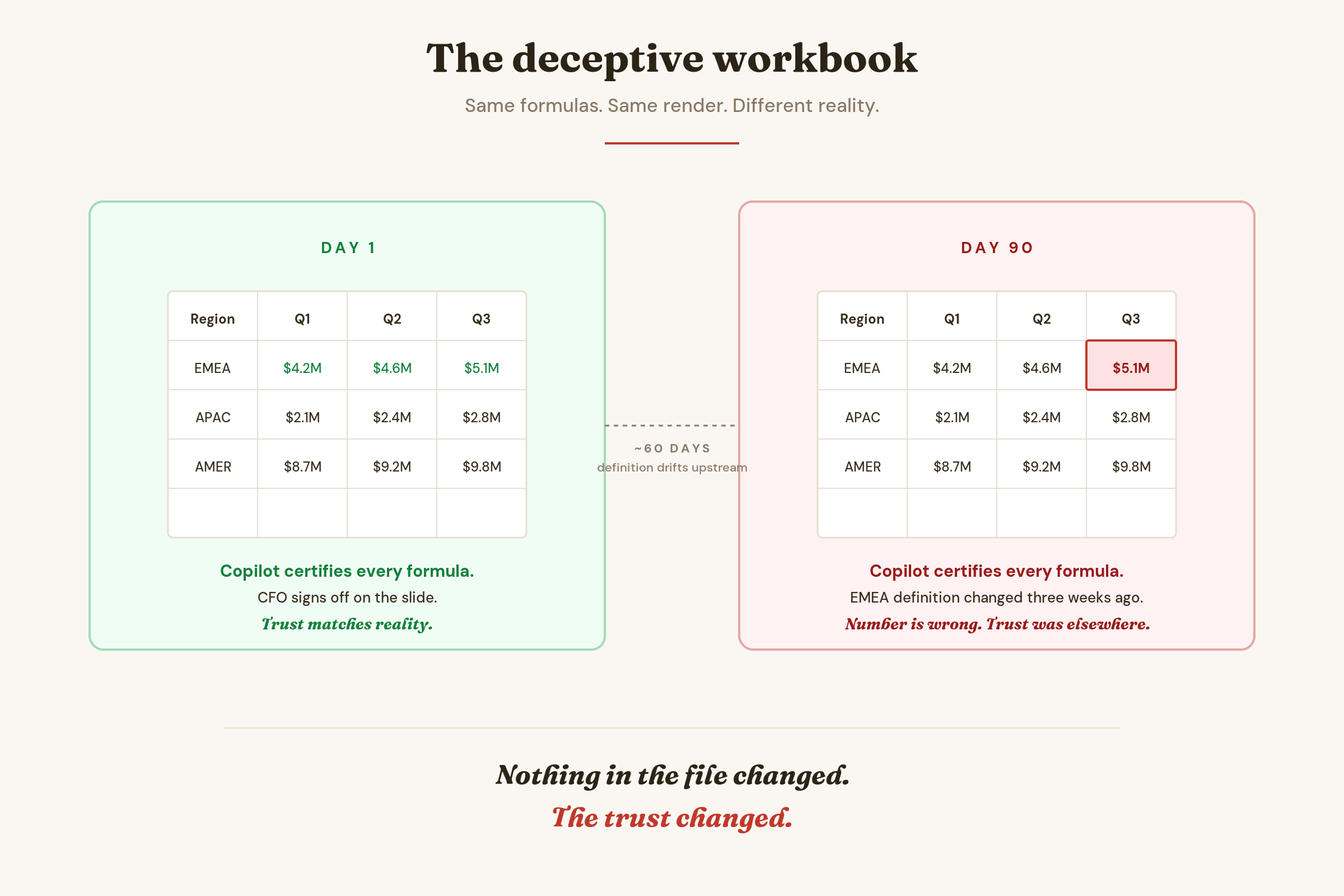
Day one of a new board deck. Every formula renders. Copilot annotates every reference. The CFO signs off.
Day ninety. Same workbook. Same formulas. The number is wrong. A metric upstream got redefined. A pipeline started skipping nulls. A dimension hierarchy shifted under EMEA. The workbook never knew. Copilot still annotates every reference. The number is wrong because trust was never actually in the file.
This is the gap Microsoft Copilot for Excel cannot close from inside the workbook. Not because the technology is immature. Because the signals that determine whether a number is trustworthy do not live in the workbook.
The Layer Split
Excel is the largest decision surface in enterprise finance. Industry benchmarks consistently put it ahead of dashboards, BI tools, and notebooks combined for FP&A use, and finance teams I work with describe their consumption telemetry the same way. Excel dwarfs every other surface combined.
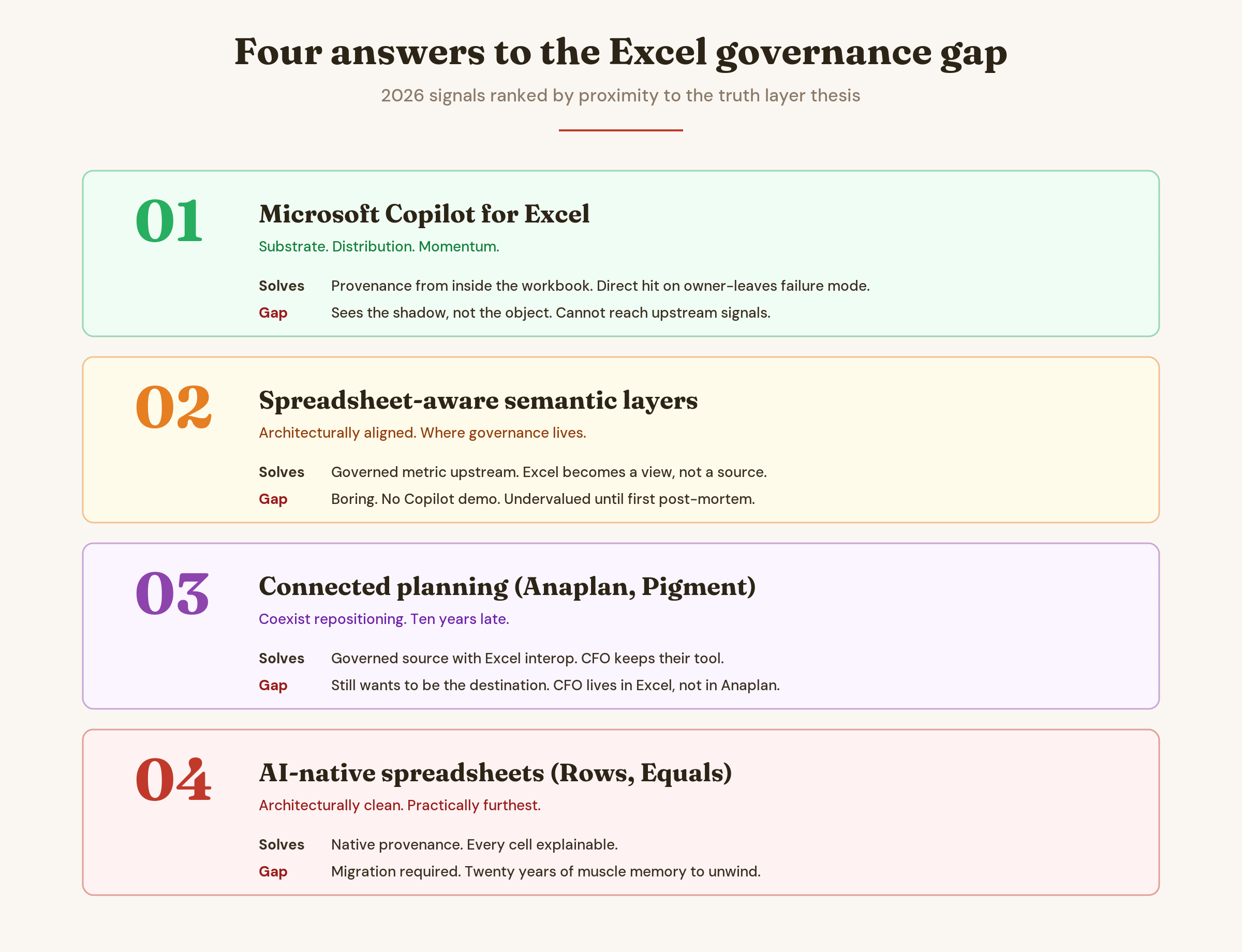
The 2026 governance landscape is converging on four answers to that reality.
Microsoft Copilot for Excel is the strongest signal. Substrate advantage, distribution, momentum. Spreadsheet-aware semantic layers are the most architecturally aligned with where governance has to live, but they sit upstream of the workbook and tend to be undervalued until the first post-mortem. Connected planning tools (Anaplan, Pigment) are repositioning from “replace Excel” to “coexist with Excel,” which is the right move arriving ten years late. AI-native spreadsheets (Rows, Equals) are architecturally clean and practically furthest from CFO adoption because they require behavior change against twenty years of muscle memory.
The competitive reality is that Microsoft will probably win the consumption surface. Trying to compete with Microsoft for the consumption layer is the wrong frame. The right frame is to identify the layer Microsoft cannot reach from inside the workbook and own that layer.
Extracted Provenance vs Attested Trust
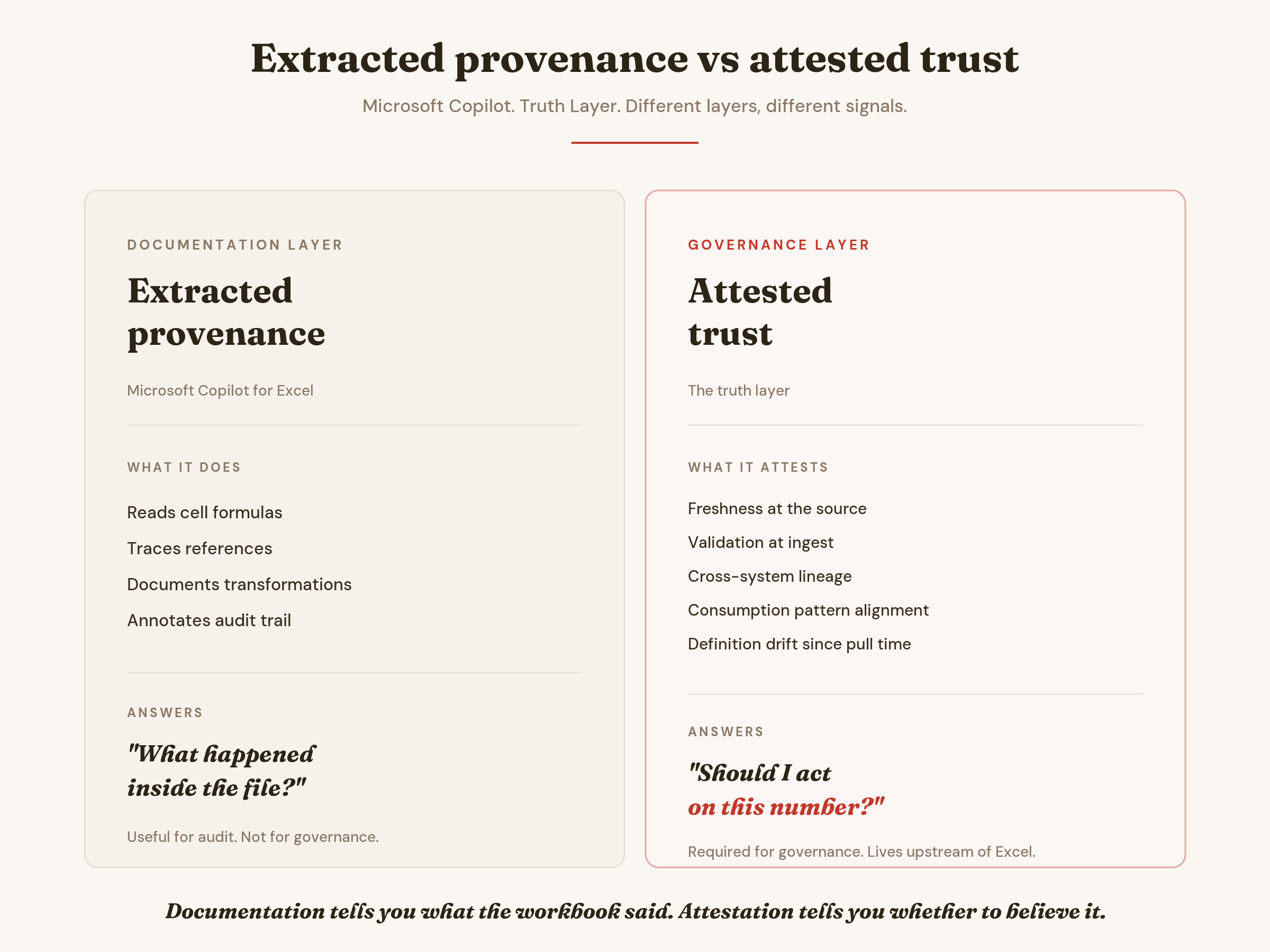
The clearest way to think about that layer split is the difference between extracted provenance and attested trust.
Extracted provenance is what Copilot does well. It reads the workbook, traces the formulas, documents what the analyst did. That is genuinely useful for audit trails, for new-analyst onboarding, for “show your work” defensibility. It is a documentation layer.
Attested trust is what governance has to do. It tells you whether to believe the number when the CFO acts on it. That requires signals that do not live in the workbook. Freshness at the source. Validation at ingest. Cross-system lineage. Consumption pattern alignment. Definition drift since pull time. Five attestations, all upstream of Excel, none recoverable from inside the file.
Copilot reading the Excel file sees the shadow, not the object casting the shadow.
The architectural posture follows from the layer split. Microsoft owns the artifact. The truth layer owns the contract that feeds the artifact. The add-in is not a product. The add-in is a distribution channel for the trust contract. When the analyst pulls a metric into Excel through the add-in, what they are pulling is the metric plus its trust contract. The contract is governed upstream. The render is Microsoft’s. Each side does what each is best positioned to do.
The QBR Scenario
The case that breaks this open is one I have been working through with finance leadership.
A QBR happens. A number on slide 7 is questioned by the CEO. The analyst pulls up the source workbook, traces the formula, finds the upstream metric. The source data is fresh. The pipeline ran twenty minutes ago. Copilot documents the formula chain in the audit panel. Everything Copilot can see is healthy.
The metric definition changed three weeks ago. The new definition treats EMEA differently after the regional reorg. The workbook formula is still computing on the old definition because nothing connected the workbook to the upstream definition change. The number Copilot just certified is exactly wrong, and the certification was honest. Copilot reported what the workbook said. The workbook said what its formulas said. The formulas were intact. The trust was elsewhere.
The architecture’s response is not a new primitive. It reuses the resolution log from earlier dual-path coordination work. An Excel add-in emits four events on cells touching governed metrics. Registration. Formula change. Dependency broken. Downstream reference added. The truth layer builds a live dependency graph per workbook. When the metric definition changes upstream, the graph propagates a confidence decay to every cell consuming that metric. The QBR question gets a green flag on the dashboard and a red flag in the cell three weeks before the meeting. (See the same cell governed by both regimes across three weeks at https://www.thetruthlayer.dev/copilot-vs-contract.)
Microsoft-accelerated, not Microsoft-dependent. If Copilot wins the consumption surface, the dependency graph still works because the events come from any cell-level instrumentation, not from a Microsoft-specific API. If the industry shifts toward AI-native spreadsheets in three years, the graph still works because the contract moves with the metric, not with the host application.
Coverage Reframed
The reason this matters beyond a single scenario is that the truth layer thesis has been waiting for an honest answer to the largest consumption surface in finance. Until the architecture absorbed Excel, the framework was rhetorically complete and operationally exposed. Coverage on dashboards while CFOs build QBR numbers in workbooks does not pass any honest reading of “trusted action.”
The reframe inside the framework is small in word count and large in roadmap consequence. Coverage as a count of metrics by surface treats Excel and dashboards equally. Consumption-weighted Coverage treats Excel as the gravity well it is. The add-in becomes the Coverage gate, not a feature that supports it. The roadmap moves accordingly.
Microsoft will tell you what happened inside the workbook on day ninety. The truth layer tells you whether to act on it.