

The Truth Layer Crisis. What’s Missing Between Your Data Platform and Trusted Decisions
28% of firms don't trust their data feeding AI agents. 89% are increasing AI spend anyway.

Alteryx and Gartner call it the “Truth Layer Crisis.” Informatica surveyed 600 data leaders and found the same pattern. 57% say data reliability is their top barrier to scaling AI. 76% say governance hasn’t kept pace. And here’s the part that should concern everyone. 65% of employees trust the data behind their AI tools, but 75% of data leaders say those employees lack the literacy to question it.
The bigger risk isn’t distrust. It’s false trust. People confidently acting on numbers they have no basis to evaluate.
The industry solved two layers. The third is missing.
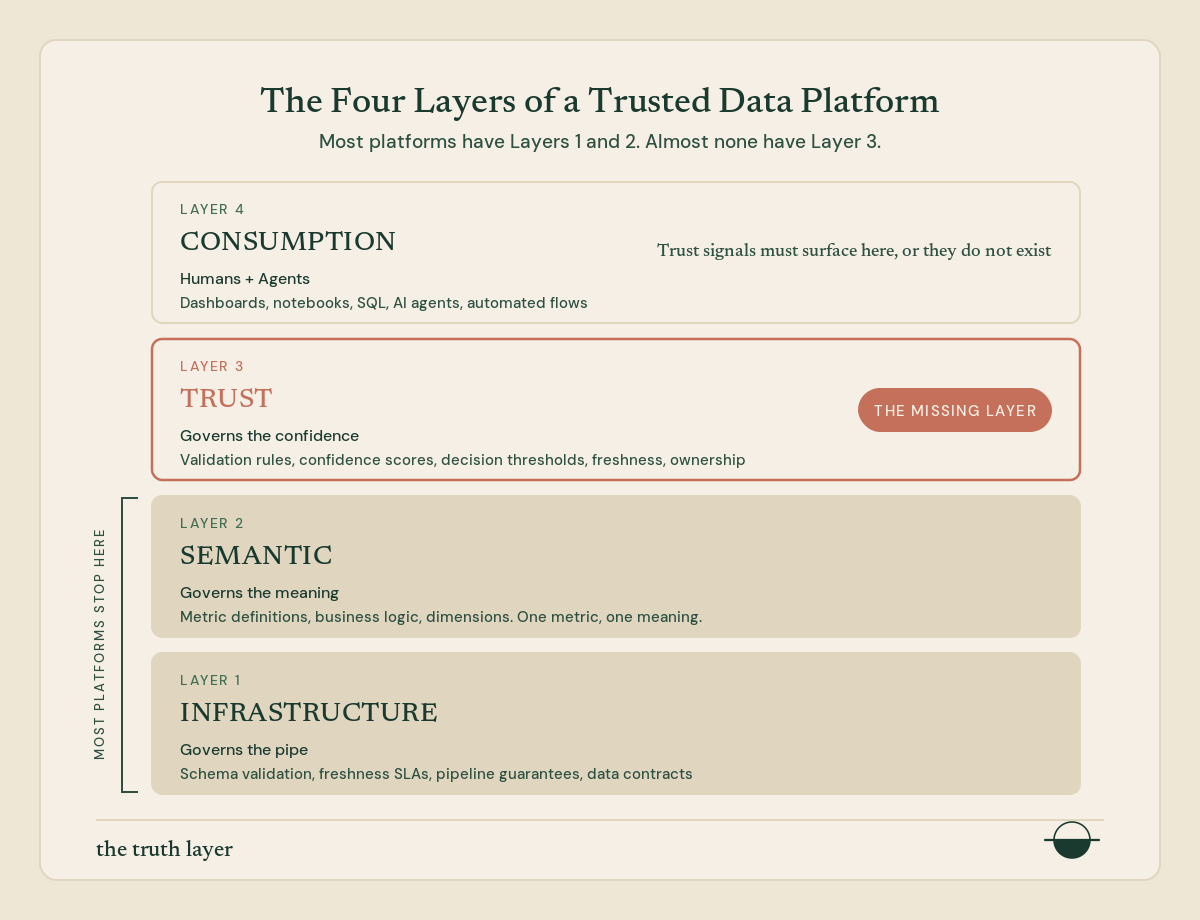
Data contracts solved the plumbing. Schema validation, freshness SLAs, pipeline guarantees. If you’re on any modern data stack you probably have some version of this. It answers one question. “Did the data arrive correctly?”
Semantic layers solved the definitions. One metric, one meaning. Airbnb’s Minerva, dbt’s metrics layer, and the broader push toward governed metric definitions all tackle the same problem. Making sure “Total Revenue” means the same thing in every dashboard. It answers a different question. “What does this number mean?”
Neither layer answers the question that actually matters at decision time. “Should I act on this number, and with what confidence?”
That’s the truth layer. Rather than adding another governance tool that lives outside the analyst’s workflow, the truth layer embeds confidence signals directly into the metric response. Validation status, lineage a business user can actually read, and freshness signals that tell you whether this number reflects reality right now or reality from three days ago. It travels with the metric into every surface it’s consumed in.
Data contracts govern the pipe. Semantic layers govern the meaning. The truth layer governs the confidence.
This becomes urgent when agents enter the picture.
A human analyst who sees a suspicious number does what we all do. Pauses, pings a colleague on Slack, checks a second source, applies judgment. That process is slow, but it catches problems.
An AI agent doesn’t do any of that. It consumes the metric, treats it as ground truth, and acts. Gartner projects 40% of enterprise apps will embed AI agents by end of 2026. Without a truth layer, every one of those agents is operating with ungoverned confidence at machine speed. The agent isn’t wrong. It’s confidently consuming data that nobody verified for the context it’s being used in.
What a minimum viable truth layer actually needs.
Not a seven-factor scoring model. Not a new platform. Three signals that travel with every metric response.
Lineage. Where this number came from, expressed in business language. Not pipeline node IDs. “Revenue feed, currency normalization, Total Revenue.” Enough for a human or agent to trace the path in seconds.
Freshness. When this number was last computed. A timestamp on every metric response. Simple, but most platforms don’t expose it at the consumption layer.
Ownership. Who to contact if something looks wrong. Accountability at the metric level, not buried in a wiki page three clicks away.
Three signals. Not twenty. Enough for an agent to make a basic “should I use this” decision. Enough for a human to sanity check without leaving their workflow. Then iterate from there. Add trust scoring, evidence checklists, and decision thresholds over time as the system proves itself.
The hype cycle is over. The reliability cycle has begun.
Gartner’s latest research identifies reliability as the number one reason AI projects fail to scale. Cisco surveyed 5,200 professionals and landed on something I’ve been thinking about for a while. Trust is no longer a risk management exercise. It’s a growth strategy.
The metric that matters most here isn’t data accuracy or pipeline uptime. It’s time to trusted action. How fast can a decision maker go from seeing a number to acting on it without asking “is this right?” That’s the real measure of whether your data platform is working.
Every enterprise data platform has the first two layers in some form. Almost none have the third. That gap is where decisions stall, agents hallucinate, and finance leaders lose another hour verifying a number that should have been trustworthy from the start.
Sources