

The Write-Back Problem: When a Wrong Agent Costs a Good Number Its Trust

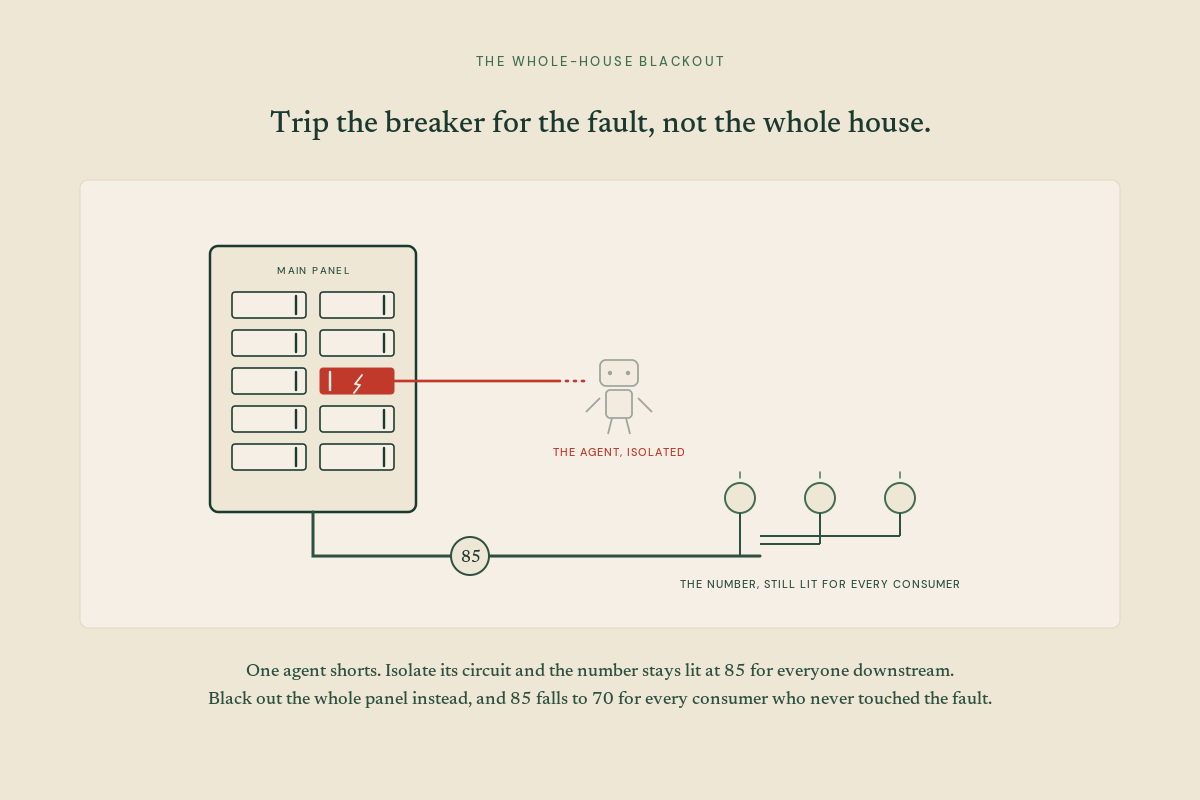
When one appliance shorts out, a good electrical panel trips a single breaker. The faulted circuit goes dark. The rest of the house keeps its lights. The whole job of the panel is to contain a fault to the circuit that caused it, so one bad appliance never blacks out the kitchen, the bedrooms, and the porch.
Most production data systems have no such panel. The moment an AI agent acts on a number and the action goes wrong, the reflex is to reset the number’s trust score. But the number may have been fine. The agent may have grabbed the wrong one. Resetting its trust blacks out the whole house for one faulted circuit, and it charges every other agent and analyst who read that same number correctly for one agent’s mistake.
The read is governed. The write back is not.
Agents have stopped only reading. They now write back. In production they initiate transactions and update records in systems of record, often without a human in the loop, and the 2026 governance literature lists data corruption propagation among the core agentic risks (Palo Alto Networks, eSecurity Planet). The danger is no longer a wrong answer on a screen. It is a wrong action that lands in a shared system and moves trust for everyone downstream.
Look at where the risk actually bites. Gartner expects more than 40 percent of agentic AI projects to be canceled by the end of 2027, naming inadequate risk controls among the top reasons. The agents are already writing back. The control for when they are wrong is what is missing. As Sanjeev Mohan put it in his Snowflake Summit readout, “the model is swappable, the governed harness is not.” The category is building the harness, the routing, the permissions, the logs. The guard on the write back sits one layer past where the harness stops.
Attribute first, then charge the right ledger
Here is the part the electrical panel gets right and the reflex gets wrong. The same late symptom has two opposite causes. The metric moved, a restatement landed or the pipeline ran late, which genuinely affects everyone who read that number. Or the agent grabbed the wrong metric, it pulled Preliminary revenue when Final had already published, which is the agent’s error and nobody else’s. One is the number’s fault. One is the agent’s. The reflex resets the number either way.
Rather than reset a metric’s trust whenever an action goes bad, I capture the metrics the agent passed over, not just the one it picked. When the verdict resolves, the system attributes before it charges. Was a closer number sitting one step away that the agent should have chosen? A cheap structural check decides whether the case is worth an expensive replay, and the replay settles fault. Then the loss routes. Metric moved, debit the number’s shared trust, because that hit is real and shared. Agent chose wrong, debit the agent’s own record and leave the number untouched. Right number, read right, still wrong, hand it to a person. The number’s shared trust is reachable only through that attribution path. No action-specific mistake gets to touch it directly.
When an agent’s call goes wrong, the question is not how much to distrust the number. It is whether the number did anything wrong at all.
The wrong twin, walked
Take the case that breaks the naive system. Finance publishes two numbers, Preliminary revenue and Final. The agent grabs Preliminary by accident and acts on it. A week later the action resolves wrong. A system without the guard resets Preliminary’s trust, and now every other agent and analyst who used Preliminary correctly reads a number that looks shakier than it earned. The guard does the opposite. It sees Final sitting one hop away, replays the decision, confirms the agent should have taken Final, and charges the agent. Preliminary’s trust stays clean.
You can run this at thetruthlayer.dev/write-back. Trigger an action that resolves wrong, choose the cause, and watch the loss find the right ledger. Then toggle the guard off and watch a good number’s trust crater for a mistake it never made, dragging down everyone who read it correctly.
Why the agent era cannot skip the guard
A human analyst keeps this score without being asked. They remember which agent burned them last quarter and they discount the agent, not the dashboard. An agent has no such instinct unless the architecture builds it one. It acts at machine speed and it would punish a good number a thousand times before anyone separated the agent’s mistake from the metric’s.
Reading is the solved, crowded half of trust. We govern access, retrieval, freshness, jurisdiction. The write back to a shared trust signal is the half nobody guards, and the closest published work guards the compute peer, the agent side, not the number it read. Time to trusted action does not survive the first wrong agent call unless the system can say why the call was wrong, the number or the agent, before the loss touches anyone else. Govern the write, not just the read. See it at thetruthlayer.dev/write-back.
Sources
Gartner, Over 40% of Agentic AI Projects Will Be Canceled by the End of 2027, June 25, 2025.
Palo Alto Networks, What Is Agentic AI Governance?
eSecurity Planet, AI Governance Becomes Critical as Agentic AI Moves Into Production.
Sanjeev Mohan, Snowflake Summit 2026: Building the Floor for the Agentic Enterprise, June 13, 2026.