

The Truth Layer, End to End
If you read one of these essays, you found a bay. This is the map.

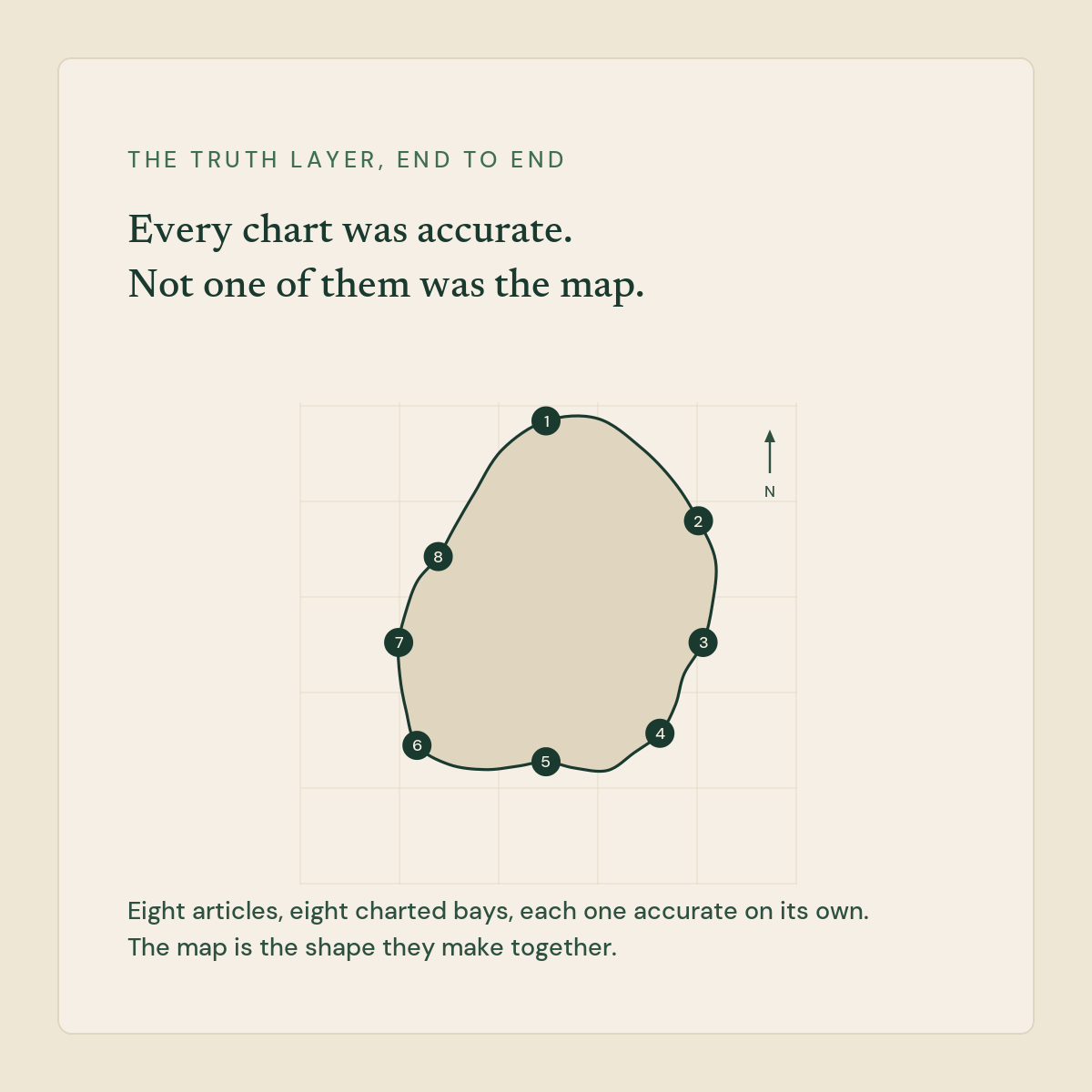
A coastline gets charted one expedition at a time. One ship maps a bay, names it, and moves on. The next ship maps the next headland. Every chart that comes back is accurate. Not one of them is the map. The map is what happens later, when someone lays the charts edge to edge and the shape of the whole continent finally shows up.
I have spent ten weeks charting bays. Eight articles, each one a survey of a single failure in how enterprises trust the data their AI agents consume. Each was accurate on its own. None of them was the map. This piece lays them edge to edge. If you are new here, this is the one to read first.
Enterprises do not trust the data feeding their AI. Industry surveys put 28% of firms at no confidence in that data, and the same firms are raising AI budgets anyway, 89% of them. Gartner now projects 60% of agentic AI projects will fail for lack of trustworthy data, raised from a 40% estimate a year earlier. The gap between investment and trust is not closing. It is widening.
The risk that matters is not distrust. It is false trust. A human analyst who sees a number that looks off pauses, pings a colleague, checks a second source. An AI agent does none of that. It consumes the metric, treats it as ground truth, and acts. At machine speed, with confidence nobody calibrated.
The industry built two layers to prevent this and stopped one layer short.
The whole map
Data contracts govern the pipe. They answer whether the data arrived correctly. Semantic layers govern the meaning. They answer what the number means. Neither answers the question that decides everything at the moment of action. Should I act on this number, and with what confidence? That is the truth layer, and almost no platform has built it. The first article in this series made that case and named the gap.
A layer is an idea until it has an artifact. The artifact is the trust contract, a machine-readable envelope that travels with every metric and carries signals a human and an agent can both read. Where the number came from. When it was last computed. Who owns it. How widely it is used. Whether the people who consumed it acted or hesitated. A number stops being a bare value and starts describing whether it can be trusted.
A contract that cannot grade itself is decoration, so the architecture grades itself. It separates the two ways an agent fails, calling the wrong metric and calling a metric whose data quietly went wrong, and treats the second as the dangerous one. It audits its own trust scores against what actually happened, because a score nobody checks against outcomes is a check engine light that has been on for two years. It classifies a definition change by blast radius and responds in proportion instead of sounding one binary alarm. It watches the consumer, because a VP who hesitates before acting is a faster signal than any dashboard. And it follows the metric to the surface where decisions actually happen, which for most of enterprise finance is a spreadsheet, and a spreadsheet drops the contract the moment a value is copied.
The method under the map
One movement is not a layer. It is how the rest got built. Rather than design the architecture once and defend it in a review, I ran a failure scenario through the design every week and watched where it broke. Each break produced an amendment that reused parts already there, which is the test of whether an architecture has absorbed a problem or just papered over it. And every claim got pressure-tested in a chat window before it reached a document, against a model with no ego and no stake in being right. What shipped is what survived that.
One system, not eight essays
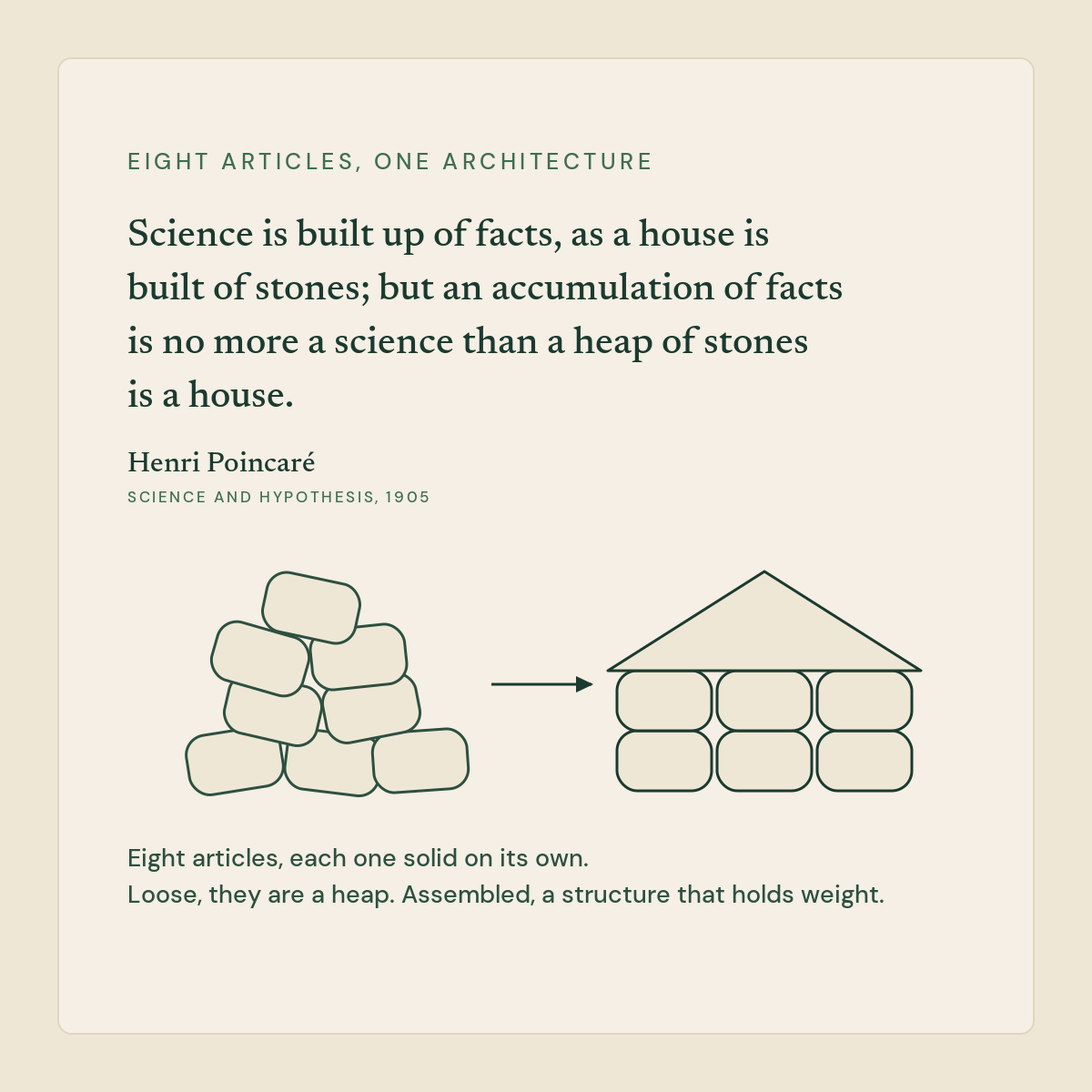
Assembled, the architecture is a single connected system. A metric enters under a contract. The contract carries its signals. The signals get graded, audited, and watched. The grade reaches the analyst in the spreadsheet and the agent at the API in the same shape. The whole loop is measured by three gates, in order. Coverage, how much is governed. Convergence, whether teams stop keeping private spreadsheets because the governed number is finally trusted enough to act on. Time to trusted action, how fast a decision-maker moves from seeing a number to acting on it without asking is this right.
I built the interactive version of this map. You can walk it at thetruthlayer.dev/map. Every layer, every signal, every failure mode, with the article behind it one click away.
Eight articles could have stayed eight opinions. Laid edge to edge they are something else. An architecture that handles failure modes it was not designed for, and absorbs problems the industry has not finished naming. A pile of essays argues a point. A structure holds weight.
If you have read one of these articles, you found a bay. The whole coastline is at thetruthlayer.dev/map. Start with the shape of the continent, then zoom into whichever bay you need.